1. Intro: Why the KOSPI is Taking a “Mental Break”
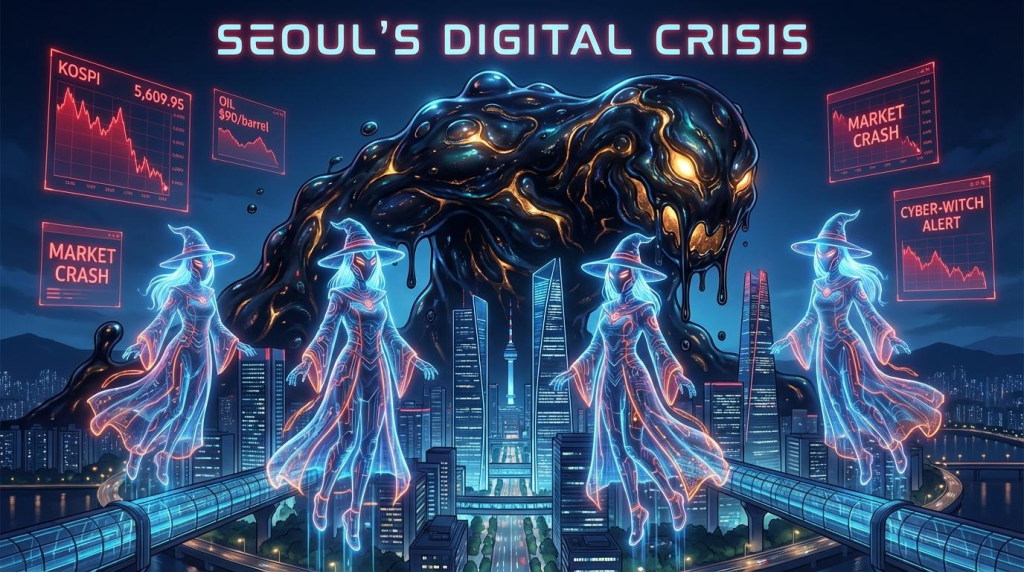
There is a peculiar rhythm to the capital markets, a cadence that often shifts from a triumphal march to a sudden, contemplative silence. For the past several weeks, the South Korean market enjoyed what many called a “victory lap”—a robust 12% rally that seemed to defy the gravity of global tensions. Yet, today, the carpet was unceremoniously pulled out. The KOSPI closed at 5,609.95, a 1.84% decline that feels more like a “mental break” than a mere statistic.
The culprits of this sudden exhaustion are a formidable duo: the “Four Witches” of derivatives expiration and a resurgent “Oil Price Monster” currently breathing down the neck of the $90-per-barrel mark. As the KOSPI clings to the 5,600 psychological cliff and the KOSDAQ slips below 1,140, even the market’s crown jewel, Samsung Electronics, has retreated from its 190,000 KRW “dream price.” It is a day of reckoning, where the euphoria of the rally meets the cold, hard mathematics of volatility and energy costs.
2. A History Lesson: Why “Witches”?
To understand today’s turbulence, one must look toward the “Witching Hour.” In the lexicon of finance, “Quadruple Witching Day” refers to the simultaneous expiration of four distinct derivatives: stock index futures, stock index options, individual stock futures, and individual stock options. When these four forces converge—historically on the second Thursday of March, June, September, and December—the market enters a state of mechanical chaos. Institutional and foreign investors are forced to “re-roll” or liquidate massive positions, leading to the unpredictable price swings that define the final hour of trading.
This structural volatility is being exacerbated by a familiar “Double Whammy.” History reminds us that South Korea, a net energy importer, rarely fares well when Brent crude exceeds $90 and the KRW weakens beyond 1,400 per USD. We are witnessing a classic Korean economic thriller: the weak Won, which should theoretically aid exporters, is currently being negated by the sky-high costs of the raw materials and energy required to run the nation’s massive semiconductor fabs. It is a pincer movement that squeezes margins and tests the resolve of even the most seasoned investors.
3. Street Talk: Is This a “Healthy Nap” or a “Deep Sleep”?
The mood in Yeouido is currently split between two competing narratives. “Team Optimist” views this downturn as a necessary, perhaps even healthy, technical adjustment. After a 12% climb, a breather is expected. These analysts are eyeing the 5,500 level as a new floor—a solid foundation from which the market might launch its next leg up once the “Witching Day” mechanical selling concludes.
Conversely, “Team Pessimist” looks toward the horizon and sees the smoke of the Middle East ground war. To them, the risk is non-transitory. If oil stabilizes above $100, the KOSPI risks entering a “Box-Range” (박스권)—a prolonged period of sideways stagnation where growth is choked by inflationary pressure. The real “moment of truth” arrives tomorrow, Friday the 13th. Whether foreign investors return as net buyers will serve as the ultimate litmus test for whether today was a temporary shudder or the start of a deeper slumber.
4. The Spicy Stuff: Is the Game Rigged?
Beneath the surface of price charts lies a simmering discontent regarding the structure of the market itself. Many retail investors have expressed frustration with the “Unfair Playbook” of Quadruple Witching. The sheer scale of program trading by giant institutions often triggers stop-losses for individual traders, leading to accusations that the “Witching Hour” is little more than a graveyard for the small investor.
Furthermore, a heated debate is unfolding over the 1,480 KRW/USD exchange rate. Is the government’s verbal and physical intervention a heroic defense of national credit stability, or is it a futile attempt to “burn through reserves” against a global “Strong Dollar” tide? This currency fragility is inextricably linked to South Korea’s “Oil Trap.” With roughly 70% of crude supplies still originating from the Middle East, the snail-paced energy transition is no longer just an environmental concern—it is a glaring systemic risk to the KOSPI’s stability.
5. The Crystal Ball: What’s Next for Your Wallet?
As we look forward, the 5,500–5,550 range remains the critical “line in the sand.” Should the KOSPI breach this support level, we may see further institutional liquidations that could turn a correction into something more ominous. The “external boss” to watch is the upcoming US CPI data; a cooling inflation print could act as a reset button for a global rally, while a hot reading would likely add fuel to the current fire.
In terms of strategy, we are seeing a distinct sector rotation. While semiconductors take a breather, the “cool kids” on the block are currently Defense and Middle East reconstruction sectors—assets that traditionally provide a “safe seat” during geopolitical unrest. Meanwhile, Aviation and Logistics remain grounded, tethered to the rising cost of fuel. In this theater of the four witches and monsters, the wise investor looks past the “witching hour” and focuses on the structural shifts that will define the rest of the year.